Civilization

Civilization is downstream of humans ability to collaborate.

All forms of human civilizations, are the result of that specific feature of humans.

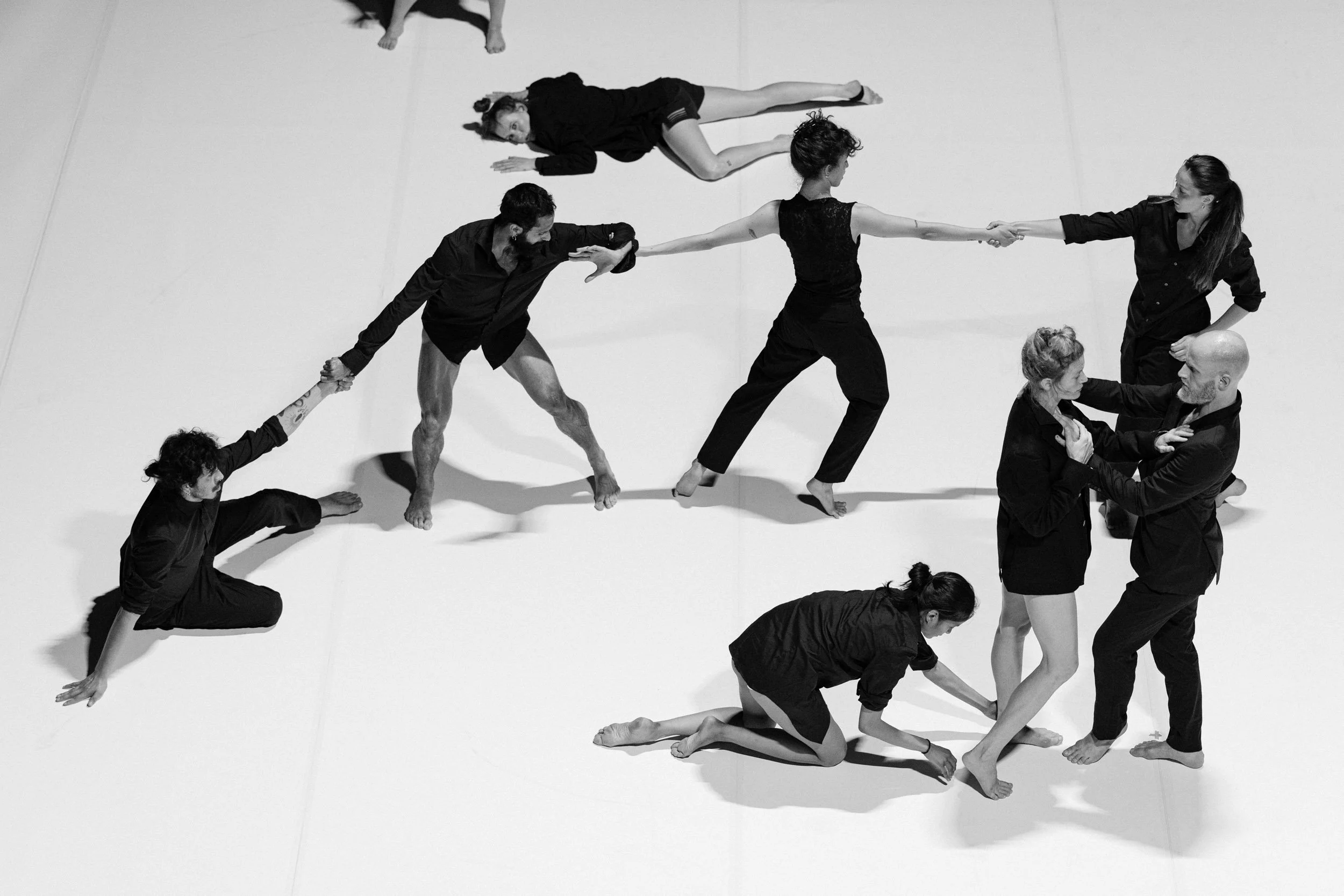
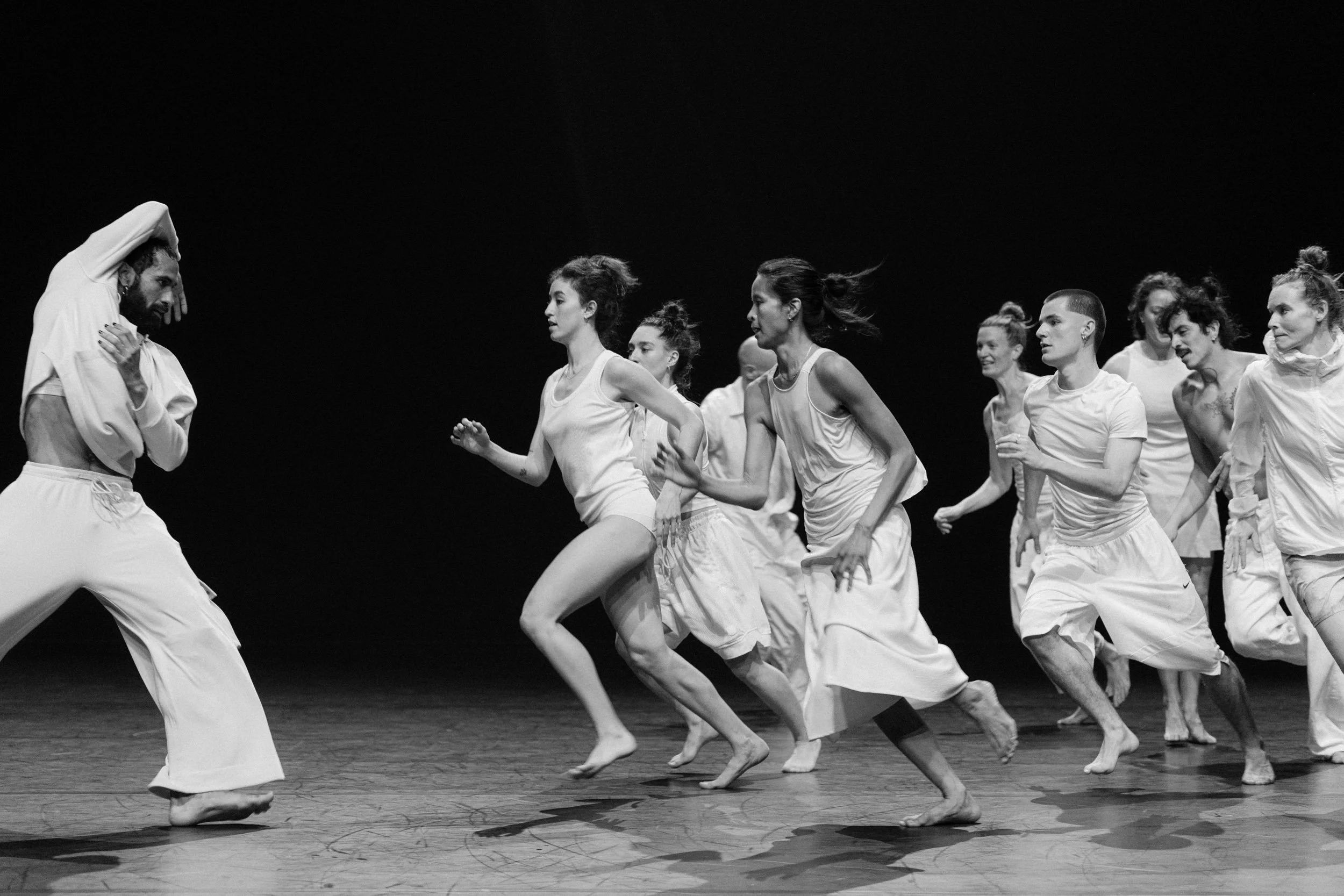
Choreography as a practice, if approached with this notion in mind, is an ideal space where one can study how human collaboration functions, which environment enhances and which blocks collaborative behavior, what type of incentives drive different types of collaborative outcomes and how the emergence of value, both for the individuals and the group, is closely related to the quality of that collaborative state of things.

In that sense, choreography, is a study of civilization itself.

Meaning

Meaning can’t be deliberately created or brought about. The only thing choreography can do, is the creation of conditions which allow for the existence of potentials for emergent meanings.

Art IS

The artistic act can never exist indirectly. Art at its best is direct. It doesn’t play around. It doesn’t suggest. It is as direct as a tree is. A bird singing. A wave braking. Art doesn’t imply or points to. Art simply IS.

Self regulation/ Non intervention

Nature is self regulating.

People, being part of nature and when left to their own devices, tend to organize themselves through self regulating groups and systems.

Any form of central regulation, has to involve different forms and degrees of compliance, coercion and violence.

Choreographies, being that their subject matter is people and groups, are in essence self correcting systems. If the conditions for this are properly set forth, a choreography will naturally and consistently self correct and regulate. It will naturally strive to reach a state of balance regarding all of its aspects internally, with little to non external intervention. It will naturally collapse into a more efficient energy state, more agency and visibility for each of the dancers and an overall higher state of clarity.

The more a choreography needs external intervention, regulation and control in order to find this balance, the more fragile it is and the more limited it is in terms of potential growth and evolution over time. This is the reason why some choreographic works keeps on changing and evolving over time, while other stifle and waste all of their energy on trying to preserve some ideal state, which was reached at one point sometime in the past.

A self regulating choreographic work is looking forward, while a centrally controlled one, keeps all of its attention on the past.

One is alive, the other dead.

Choreographing then, is the act of carefully setting the conditions for such a self regulating system to emerge.

Peer to peer choreography

I never felt choreography is about dance, movement, the body, concepts, ideas, stories, political ideologies etc. That to me would be like saying water is about drinking, or swimming. Whereas what water is, is simply a chemical interaction between hydrogen and oxygen. You can drink it, swim in it, harness it to produce electricity etc, the water doesn’t really care. Non of the things one can do with water, actually defines what water is.

Choreography the way I see it, on its most profound level, follows the same logic. And maybe this explains best why choreography as a practice, is actually a small niche within what is usually referred to as - The dance world. The inherent confusion that dominates the field, has drowned the practice of choreography under a sea of use cases, to the point where it has almost become extinct.

Choreography doesn’t care what you use it for. It is separate from all that which it enables. And so if we look beyond what it allows and the use cases for it, in order to really SEE choreography for what it is at its highest form, what we can observe is that what choreography is actually made of, are interactions. That’s all.

If looked at from that angle, what choreographing means then, is creating the conditions for interactions. Therefore, when evaluating the intrinsic value of a choreographic work, one needs to first of all analyze its model of interactions management.

Art is in essence, a way to capture energy in an abstracted form. The specificity of the choreographic form, is the manner in which it manifest human time and energy in a concentrated, concrete, embodied form, through dancers’ being and doing. In that sense, it’s a unique form of concrete abstraction.

In other words, choreography is a base layer, a decentralized protocol, which allows dancers to harness, convert, channel, store and share their time and energy through the creation and the performance of a choreographic art work.

When looking at the way in which interactions are managed in the context of choreographic works, there are two models when it comes to how interactions happen - they can be centrally controlled and organized, or they can be peer to peer and decentralized.

People are always the subject matter of choreography, but it is the model and the system they are operating within, which defines the quality of the work. And when it comes to the different modalities of interactions dancers have access to, it is quite apparent whether they can interact freely with one another or not. It is easily observable whether they are operating from an autonomous, sovereign position, or if they are bound by an external authority who centralizes, pre-determine, control, limit, script and manage their actions.

There will always be far less visible interactions between dancers when they operate within a centralized system. Since all the action is determined by a central entity, it simply cancels the need for interaction and communication between the individual dancers. They will have almost no need to look at each other, no need to negotiate, no need to actively exchange about the thing happening etc.

On the other hand, the first thing which is strikingly visible in a decentralized choreographic system, is dancers’ constant eye contact, the on going state of negotiation regarding the moment and the thing taking place, the intense dialogues they are having with one another, not as a dramaturgical tool or theatrical content, but as a pragmatic necessity. A decentralized choreographic system, not only allows for that, it actually forces dancers to engage in constant peer to peer interactions, transactions, negotiations and so on. The quality, stability and coherence of a decentralized choreographic work, is a direct result of the richness, complexity and intensity of the sum of peer to peer interactions dancers are having between themselves.

But for this to happen, the choreographic protocol, has to be one which clearly enables, allows for and prioritize peer to peer interaction between autonomous, sovereign players within a network-like environment. It has to generate a set of incentives, where peer to peer interaction is the most efficient and beneficial action the dancers can engage in, both personally, as well as for benefiting the whole, as in, all other players, everyone involved in the production on and off stage, the work itself and as a result, the audience. For this to be sustainable, one has to ensure no centralized control, regulation, censorship, manipulation or management of the interactions taking place between the dancers, takes the upper hand.

The role of the choreographer then, is the creation and constant improvement of an open, neutral choreographic protocol.

Nicola Tesla famously said that if one wishes to understand the univers, one needs to think in terms of energy, vibration and frequency. Dancers energy, stored in their body and mind, translates into frequency though the vibration, which  surprisingly, isn’t happening as a result of their movements, but rather, through the interactions they engage in with one another. Just like the energy stored in a players hand, transform into sound frequency through the vibration of the string put into motion, the vibrational force which transform dancers’ energy into frequency, is happening in the realm of interactions. The strings vibrating, are dancers interacting.

Choreography then, is a technology that allows for these interaction to happen in the most efficient, productive and meaningful manner.

Know when to leave

If a choreographer steps into the studio, starts moving, and expects you to copy them, leave the room.

Against Repertoire - How did repertoire, ossified the natural evolution of the choreographic art form.

All the art forms that produce objects, artifacts, scores, texts, recordings etc, all of which remain available beyond their time of creation, sometimes literally for millennia and more, do so with the clear intention to transcend time, which in many art forms is a core drive for artists. The choreographic form on the other hand, is an art of its time. It refuses to be replicated in a meaningful way outside of its creator’s lifetime. All attempts to treat choreography like classical music for example, by holding on to scores of sort, mapping choreographic content as a series of movements and compositions in order to reconstruct a choreographic piece, result in nothing more than pale, artificial, awkward, lifeless and unoriginal replicas.

Choreography is an art from bound to its ephemerality as a performative art, but more than that, it is bound even stronger to its inevitable mortality as all living things are. It is unique in that sense that it is probably the one art form, which represents the cycle of life in the most profound manner. A choreographer’s ’touch’, is as singular and imperative to the art work, as that of a painter. It can’t be replicated by anyone who’s not the actual maker in a way that produces an original art work. In the same way a copy of a Picasso isn’t a real Picasso and is considered a fake, all choreographic works that were replicated in the absence of their original creator, are all forms of fake art works.

One simple analogy to illustrate the problematic nature of choreographic repertoire, would be to try and imagine how it would look if the cinema industry behaved in the same manner.

Imagine a world, where the majority of cinema productions today, would be re-production of old masterpieces of the genre. Imagine most of the current cinema world, being about reconstructing old films, as close as possible to the original thing, just with a new cast of actors. Same script, exact same camera shots, same locations and same art, same costumes, same type of acting, same dialogues, same editing, same soundtrack, same type of equipment at the time of the original production in order to produce the exact same visuals, same lighting, same everything. Literally, the same movie, just recreated with new actors and a new technical and production team. Imagine the main goal of all this, being the production of an identical film to the one copied, with the same title of course. How odd would that be?

well, that is exactly what is happening with most of the dance productions being created and presented.

Obviously, that realty has a major impact on the ability of an art form to evolve. Continuously recreating replicas of past art works, changes entirely the way new works are being created. If the cinema industry would invest most of its ressources in recreating the filmography of Hitchcock, Fellini or Godard, again and again in many parallel productions all focusing only on this, eventually, there wouldn’t be any possibility for new cinema artists to emerge, innovate and take the art form to new places. There would probably be no Tarantino in that imaginary world.

The difference between why this happens in dance but not in cinema, is obvious of course. Cinema produces recordings, filmed objects (which is the essence of the medium itself), and therefore, if one wishes to watch an old movie, they can do so easily. There’s no need to reproduce the thing as there is access to the original.  In dance, there’s no real possibility for that. And so for reasons that are all unrelated to the nature of the art form, the majority of the dance world has gradually shifted towards the production of replicas.

But the logic of the analogy, relates primeraly to the nature of these two art forms and therefore, it holds.

What happens on a movie set, the way a script is translated into images, the way a film is edited, all of which is orchestrated through the physical presence of the movie director, is the exact same thing which happens in choreography. It is the sum of the decisions a choreographer takes, and the time spent in the same space interacting with the dancers, that makes a choreographic work what it is. It cannot be summed up in any score. It’s the thing all living interactions and organismes are made of, and like all living organismes, it is alive only till it ceases to be. Once dead, no living organism can be brought back to life and new life takes the place of that which has died. Keeping alive that which has died, is an inherent impossibility. Things which are alive, are alive through the singularity of their specific aliveness, only for a limited duration of time.

The choreographic art form, doesn’t need the obsessive remounting of the works of Petipa, Balanchine, Cunningham or Bausch (all probably rolling in their graves). Their art would anyway be transmitted through the generations in the same way people transfer their DNA to their offsprings. Nothing would have been lost on the way. On the contrary, that is what allows for evolution through natural selection. What stays, stays for a reason. What is lost, is lost for good reasons too.

The insistance to keep directing most of the attention and ressources of the field towards preserving these dead works of dead artists in an artificial manner, ossify what needs to be a dynamic and ever evolving process of evolution. It is a literal weight holding back what would have otherwise, be a natural process of continuous and organic evolution.

But even worse that this, what the growing presence of dance repertoire has done is, it has pushed most makers to create works that are in tune with this logic. Choreographers, consciously or not, are creating works which can be recreated in their absence. It’s as if the notion that a choreographic work must be summed up in a score which will enable its reproduction in the future, regardless of the presence of its maker, became inherent to what a choreographic work is thought to be. Something like - If most of the work being produced and presented is by dead choreographers, I better make my work in a way that aligns with that logic.

The choreographic art form in the west, developed in the same artistic and cultural circles as those of the already well codified music world, which is probably the reason for the adoptions of certain logics regarding repertoire, scores, notation and the overall attitude regarding the preservation of an oeuvre over time by the choreographic world. The problem though, is that although music and choreography share many aspects related to the manner in which they think about and structure their respective artistic materials, they are completely on opposite sides in relation to the ability to summarize the essence of the work in the form of a fixed score. This relates to the fact that music, being the highest form of artistic abstraction, lends itself naturally to the logic of notation systems. It is very much detached from the time in which it was made and the people who made it, while choreography, probably the most concrete of all art forms as it’s made with, by, and through people’s bodies and consciousness, rejects all attempts to be fixed, notated, and reduced to any type of score. But also, it is extremely limited in its capacity to preserve its core essence when it is being kept alive beyond a certain amount of time and disconnected from its creator’s singular ‘touch’.

All things abstract, travel lightly through time, while that which is concrete, does not. That’s why we can converse with and relate to ideas from thousands of years before our time, but as much as we would have liked to, we cannot meet the actual person who developed them for coffee and a chat.

Trying to maintain alive a repertoire of choreographic works, is to misunderstand and limit choreography. It is like insisting on physically meeting a person who has died.

A choreographic art work, is tied to the inevitability of its own mortality like no other art work in other domains is. To resist this reality, is to harm, slow down, divert and block its evolution. Letting go, as a practice but also a deep philosophical idea, is the first and last thing to understand when it comes to choreography as art.

Choreography

Choreography is just one way, among many others, to try and understand the nature of the univers. It’s a series of questions, formulated through the practice of organizing human action in time and space.

The entire choreographic process, is about figuring out possible effective questions. Every choreographic work which attempts to, and is focused on providing answers, is anything but choreography, or art for that matter.

The choreographic game happens only in the presence of questions, followed by observation, which leads to more questions.

The great replacement

If art is not about the Devine, that which is sacred and therefore makes present a world view guided by and striving for a moral outlook on everything that is, then it is bound to be replaced by a maniacal race for power, pathological hedonism and self centered nihilism.

2x15

If I need to resume everything I’ve learned about choreography in the first 15 years I’ve been practicing it, it will be the flowing:

There are two ways to approach choreography, one is inventing, the other is uncovering.

One can either pre plan, pre decide, come up with a finite concept, idea, story, content and so on, and then use the choreographic process in order to manifest that thing, which was pre planned.

Or, one can use the choreographic process in order to discover, or uncover existing logics, systems, mechanisms etc, as a way to tap into what already exists. To try and figure out what already IS.

If I try to summarize what I learned during the next 15 years of working with choreography, it would be something along these lines:

The first approach to choreography, the one who tries to invent an art work, is dependent on the presence of a centralized system/creative process.

The second, can only happen in an environment based on modalities of decentralization, where everyone involved has both a say and a stake in the process and resulting work.

Choreography, the way I see it, is a process of figuring out the best strategies for allowing the creation of a system, which enhances collaborative behavior through sets of incentives and emergent consensus. For this to happen, the impact the decisions of each separate, self governing, sovereign, free player has over the whole, must be significant, and the model under which the choreographer is working, must imply a well defined type of authority and leadership, one which is able to see the work through the eyes of the dancers and is restricted mainly to that which is absolutely imperative to keeping a decentralized system functional. The choreographer aught to be the assistant and the foundation of the choreographic thing, nothing more, nothing less.

How and why did the state become the patron of the arts?

We live in times of excessive quantities and ever receding quality when it comes to artists and art.

One, rather surprising explanation for this, might be the central role the state has taken in the past century or so, through the public funding of artists and art in general.

The notion that the state, as a sort of paternalistic entity, is supposed to have a say in, regulate and fund the arts, and as a consequence, gain a significant control over the field, is in many ways destructive to the ability of the different art forms to naturally evolve, innovate and regulate themselves.

The centralized public funding of the arts, through the incentives it generates, the inherent conflicts of interests it creates and the corruption that comes with it, has created a distortion in the process of natural selection and the overall evolution of different art forms. The more a specific discipline is publicly funded (and contemporary dance is probably one of the most publicly funded art forms in terms of percentages), the more that distortion is apparent.

By placing itself in the space between artists and their audience, in the form of a bureaucratic, middle management sort of apparatus through its institutions, public funding and designated gate keepers, the state has created an inflationary system. It has gradually and over time, devalued and debased art and artists. It has lowered the intrinsic value artists and their work had within the society, simply by putting in place an artificially sustained, centralized system for the regulation of a thing, which is by nature, decentralized and self regulating. It has created a web of incentives for both artists and the bureaucrats of the art world, which are by definition, anti-art.    

The result? A massive inflation in the number of artists, art works, art schools, art institutions and the art industry as a whole, all of which translate to an ever growing artistic mediocrity. In a quite surprising turn of events, the state has done to art, what McDonald has done to food.

This reality, can’t be seen more clearly than in the contemporary dance world.

Most active choreographers nowadays, would never end up choosing a career in choreography in the absence of public funding, the many institutions dedicated to dance and the gate keepers which direct them (most of whom have little, or no understanding what so ever, of the art form). The majority of active choreographers under this system, were taught, pushed, selected and put in place by bureaucrats of sorts, whether they are teachers, artistic directors, bureaucrats of sorts and small time politicians, non of which are remotely able to asses a person’s talent and ability to produce value through art making (The current trend of legitimizing everything amateur, be it the performers or even the actual choreographers, as if there can be any artistic value in something simply because it resides outside that which is considered to be professional, is but one example to this twisted reality which is as destructive to the art form, as it is evil.)

What massive public funds do, is they pull people into the field for all the wrong reasons - artists, but also an entire class of parasitic bureaucrats who feed off of these ressources and the power that comes with them. It has created a parallel reality, where everything that makes someone an artists in a specific discipline, everything that is primordial, becomes almost irrelevant, while other aspects of a person’s personality, drive, motivations, skills and talents, all of which are completely unrelated to art making, become indispensable.

Public funding of art, controlled by the apparatus of the state, has a diluting effect. It compounds mediocrity, rather than excellence and merit, and It does so by pulling and letting in way too many players for the wrong reasons, and as a result, it dilutes the notion of art itself. It breeds stagnation and unchecked incompetence and by doing so, it corrupts the very notion of what art is.

What Art needs in order to do its thing, in order to be valuable, is scarcity.

The current catastrophic state of the choreographic art form, is to a large extend the result of its entanglement with the apparatus of the state’s central planning and control. The only way to save it, might be to separate the state from the arts.

By way of bottom/up observation, when looking at the end result in order to understand the system which enables it, one needs only examine the level of the works being presented and who are the leading, most subsidized makers in the states which heavily fund contemporary dance, in order to realize how badly this dysfunctional, panoptic system, has failed.

The arts for that matter, are no different than any other aspect of society where trying to provide something in a blanket governmental manner, leads inevitably to it being destroyed by misallocation, over management, hyper regulation, centralized planning and so on.

The answer to - why does the state wishes to take upon itself this role in the first place?, holds the key to two other primordial questions:

What is art?

Why do people and societies need it?

When examining the two models for funding and regulating art in the western world of the past few centuries, the main striking difference which emerges is - the church wanted the best art and the best artists to serve its domination purposes. While the state who replaced it, wants the worse art, worse artists and as many of them as possible, as a strategy for its domination and control over the masses. 

The apparatus of the modern state in the west, heavily influenced by post modernist ideas, has made art un-important by design. It has made it common, cheap, shallow, insignificant. It has followed the same trajectory it has taken regarding money and its financial systems.

In the same way and very much for the same reasons all modern nation states have abandoned the gold standard, or any other notion of sound, hard money and shifted to a corrupted, easily manipulated, centrally controlled system of hyper inflated worthless fiat currencies, stepping away from a system which was based on a thing of undeniable hard value by way of its scarcity and natural, unmistakable signature of authenticity, the state has abandoned the hard value art had since the dawn of time, and replaced it with an inflationary, corrupted, easily manipulated, centrally controlled and worthless artistic like currency.

The church was about enslavement through the spiritual realm, while the state aims for economical enslavement and therefore, it must erase the spiritual. With the decline of religion in the west and the rise of post-modernism, the eradication of the spiritual had to go through the impoverishment of art.

The first thing that needs to come back into the equation, for Art to be able to re-align with its fundamental role within society, is the spiritual. Not as a tool for control, but rather as the indispensable aspect of human existence that it is.  And the spiritual, in relations to the arts, can only flourish in direct relation to scarcity.

We need a new model. One which doesn’t take art, artists and the audience hostages in the service of interests that are all foreign to the raison d’être of art.

We need a new model for our society which produces less artists and less art. We need less quantities in order for notions such as craftsmanship, excellence, quality, originality, rarity and spirituality to once again be the defining ones when it comes to art.

The quality of art, is a reflection of the quality of the culture and civilization it enables. Craft-less, self indulgent, low quality, narcissistic, hedonistic, nihilistic art, makes for a disoriented, confused, dysfunctional, low quality society, and conversely, competent, well crafted, virtuous, high quality, spiritually driven art, makes for a strong, functional and high quality society.

The current crisis in the arts, is but a reflection (or maybe it is the source?) of the larger crisis our civilization has plunged into. It is primarily, a spiritual crisis.

We need a change.

“Distinctions in society will always exist under every just government.

Equality of talents, of education, or of wealth cannot be produced by human institutions. In the full enjoyment of the gifts of Heaven and the fruits of superior industry, economy, and virtue, every man is equally entitled to protection by law; but when the laws undertake to add to these natural and just advantages artificial distinctions, to grant titles, gratuities, and exclusive privileges, to make the rich richer and the potent more powerful, the humble members of society—the farmers, mechanics, and laborers—who have neither the time nor the means of securing like favors to themselves, have a right to complain of the injustice of their Government. There are no necessary evils in government. Its evils exist only in its abuses. If it would confine itself to equal protection, and, as Heaven does its rains, shower its favors alike on the high and the low, the rich and the poor, it would be an unqualified blessing.”

Andrew Jackson

Pina

Thinking it’s possible to make a Pina Bausch without the physical presence of Pina Bausch in the studio, is like trying to make a Picasso by copying Picasso.

Chorégraphies are originals in the exact same way and for the same reasons paintings are. You can’t recreate a choreographic work just by following a score, in the same way you can with classical music. The two art forms are on totally opposite sides in that regard.

The notion that it is possible to replicate on demand the thing which takes place at the meeting point between a choreographer and dancers, without the choreographer being present, is a joke.

Choreography requires the physical presence of the maker and dancers in the same space and over time. It’s this aspect and this aspect alone, that makes the work an original.

All the rest, is a fraud facilitated by how deeply choreography as an art form, is misunderstood.

But also,

Everything that is alive, is alive through the inevitability of its own death. Death is what allows for renewability. Death is what allows for new life to happen.

The poisoned cocktail of human fantasies for eternal life, mixed with the dance artists’ petty enviousness of the other art forms who produce objects and therefore, exceed the life time of their makers, sprinkled with a deep misunderstanding regarding the unique essence and primordial importance of the ephemeral aspect of choreography as a living form, has literally destroyed it over time. Dead artists’ repertoire, is the main reason why the contemporary scene is so dull, incompetent and un inspiring.

The only way to see a new Pina emerging, is by stopping to do dead Pina works all together. The fact that this notion seems so radical in the context of the current dance world, is anything but reassuring.

WHAT, HOW, WHY

Nature is WHAT and HOW. It just IS.

Choreography, since it is human made, is WHAT, HOW and WHY.

The WHY though, cannot stand without solid foundations of WHAT and HOW.

People can tell their stories only in the context of the natural world. Trying to do the WHY, in the absence of well crafted WHAT and HOW, is what’s wrong with most art works.

Fraud alert

Whenever choreographers claim they want to chalenge and reconsider the existing means and forms of performance and presentation, it usually means they are un able to choreograph. When you have no idea how to play the game, you turn the table over.

Shout out to the godfather of talentless wannabe artists, Mr Duchamps…

Art making is a craft. It requires proof of work, talent and competence, in order to generate value. That doesn’t mean art isn’t constantly evolving and that innovation isn’t fundamental to the artistic process, it just means that there’s no possibility for valuable art making outside of the premise of what art making IS. And this, the premise itself of art, isn’t negotiable.

Sadly, choreography is one of those art forms, where a choreographer can be utterly incompetent and still be successful for many years before it is being noticed.

Interpretation

Interpretation of a choreographic work while it is taking place, is a waste of time. It makes the viewer blind to the actual THING which is happening.

Choreography needs an undisturbed state of looking. Interpretation, gets in the way. It generates information that is external to the essence and embodied experience of the choreographic thing, hence, it takes the viewer out of that which is happening here and now.

The experiencing of a choreographic work, happens when the brain is quiet, present, un interpretative, not looking for meaning, a story, concepts, messages. It happens when there’s space for an experience un bothered by thought.

The way to look at choreography, is simply to LOOK at it. To shut down the chattering, analyzing, interpreting parts of the brain, so a full undisturbed experience can take place.

When looking at the ocean, a flower, a sunset, the looker’s experience has to do mostly with the fact no interpretation or analysis is involved. Even when the looker is a marine biologist, a botanic or an astronomer, the moment of looking and experiencing these phenomenas, is separate from the analysis and research into them that occurs in different spaces, times and states. One doesn’t need to study astronomy, in order to fully experience a sunset. Even the astronomer, has no need for the knowledge he has regarding his field of study, for a full experience of the sunsetting moment.

Choreography, probably as a result of its false linkage to theater, being that dance is usually performed in the same spaces, suffers from the automatic reflex of viewers to try and interpret the thing which is happening. To try and decode hidden meanings and messages, storylines, concepts and themes. This pressure, naturally pushes many choreographers to actually make work that delivers all of these, literally, just so they have what to answer when faced with the question - what is the work about? The result is a vicious circle of both choreographers and audiences loosing touch with the physical embodied experience the choreographic art form requires.

True knowledge, true knowing, is visceral, rather than cerebral. Real learning, real understanding, happens through an embodied experience rather than the cerebral analysis of the thing taking place. This is why choreography needs to be experienced, rather than interpreted, as interpretation is a hindrance to understanding.

That being said, there’s nothing in the above to undermine the importance and need for interpretation and analysis of choreographic works. The two are complementary. This text, is just that. But there are distinct places and times for it, non of which, is the actual moment of LOOKING at the work taking place.

Is dancing art?

I dont think dance is an art form. Dance, in itself, can not become art. It’s more a form of artisanal craft. Like pottery. It can be of course pushed to levels of craftsmanship so high, that it reaches the highest spiritual levels. Yet it can’t become art, simply cause it lacks some of the aspects that makes something an art work.

Choreography, has the capacity to become art. To be art. It might use dance in the process, incorporating its qualities as a craft form, but what allows choreography to be art, has nothing to do with dance and dancing.

The wider or deeper question on this, is whether the interpretation or execution of any art form, separately from the artist who created the work, is in itself, art.

We naturally define everyone who performs or interprets art, an artists. But this begs a deeper look. First of all, there’s a distinction to be made here, between art forms where the two are linked and overlapping, like in painting or sculpture for example, who traditionally tie together both things (if we ignore more modern ways of creating visual art works in factories like ateliers, with assistants carrying out the orders of the artists), and other forms of art like music where, at least in the western classical music tradition, the separation between the creator of the musical score and the musicians interpreting it, was distinct.

Picasso was both the artist creating the work, and the painter who executed it. The two are in distinguishable. Inseparable.

Glen Gould on the other hand, one of the most prominent interprets of Bach’s keyboard music, was an extraordinary interpret of the profound art created by Bach centuries before he was born. His own attempts at writing music however, as interesting as they were, could not match the overwhelming artistic depth and value of those of Bach he so well played. Would Gould become the pianist he was without the work of Bach? It’s hard to say of course, but I would risk saying that probably not entirely in the same way.

So when we look at the clear distinction between the art work, and its interpretation, we can’t avoid asking the question regarding the essence of the artistic thing. Its source. The act which makes a thing art.

So is dancing art? I’m not sure.

Choreography is a process of figuring out and highlighting logics and systems of interaction. Hence, it has to address the question of how things relate to each other through time and space.

The difference between dance and choreography, is like the difference between masturbation (great thing I have nothing bad to say about it) and love making. One produces self knowledge and pleasure, the other produces life. Art needs to produce life. In choreography, Interaction, is the life-force, not the dancing.

As someone who danced in many of his own works, I know for a fact that the artistic thing I’ve made, was separate from my dancing of it. That it is not my dancing that made the art piece what it was. That the work could easily be danced by other dancers without losing anything of its value or essence. That my interpretation of my own work, was just that, my interpretation. One among an infinite number of other possible interpretations.

So it is quite clear to me, that my artistic act, the space where I made the art work, wasn’t the dancing. It was somewhere else. And that my dancing, was a form of reading into the art work created by the other me, in that other space. The dancing in itself, never felt like art making to me.

I feel that one of the major problems of choreography, is the misunderstanding into what choreography is as an art form. Where exactly lies the artistic substance in the context of choreographic works and how it’s totally separate from the dancing or interpretation of it.

Naturally, just like with any other art form that requires interpretation and execution in order to be, the more creative, intelligent, technically proficient, knowledgeable and original the interpretation is, the more the artistic essence of the work shines. But you can hardly say the opposite. The best dancers, executing a lacking choreographic art work, have no ability whatsoever to circumvent that lack in order to produce artistic value. Can’t happen. You simply can’t dance yourself into an art work if you’re not on a choreographic platform.

But choreography, and the very specific manner in which it links the creator with the interprets, has yet another aspect which renders it different from any other interpretative art form. It requires direct contact. Unlike music, you can’t reduce it to a score that can travel through time and space. As choreographer, you need to be here and now with the dancers, throughout the process, if you want the work to actually happen. There is no way to dematerialize it. To outsource or delegate it. If you want to make choreographic art works with dancers, you need to be in the same room with them. Overtime.

It’s as much an energetic thing as it is an intellectual and conceptual thing. In a way, it’s like you can’t make a Picasso if it’s not Picasso who actually touched the brushes, colors and canvas. And just like you can’t recreate a Picasso simply by copying it, you can’t reproduce an original choreographic work in the physical absence of the choreographer. In that sense, choreography resembles painting much more than it does music.

Oops, here goes all the concept of dead choreographers repertoire out the window.

So back to the first question, is dancing art?, I guess it depends on the definition of ‘ART’.

Why does it matter? Well, maybe because if we manage to understand what art IS, we’ll be able to see better what it is not.

Censorship

Censorship is defined as the suppression of speech, public communication, or other information. Depending on the context, it is usually conducted by the entity considered as authority, and which holds the power to enforce it. Other types of censorship can be self imposed.

Almost every system that surrounds us and that we are part of, includes different layers and types of censorship. Enforced, or self imposed.

Choreography is no different. in some ways, censorship is the main tool of work in the choreographic field, enforced (consciously or not) by choreographers over the individual dancers, clearly visible in the manner in which it manifests visually in a choreographic context. It is so engrained into the notion of what a choreographer’s role is, that’s it’s almost invisible.

There’s a growing need to think about a model for censorship resistant choreography, one that is a self sustaining, self governed, self stabilizing system, where the authoritarian, centralized censorship option, has been canceled.

This has to do mainly with deciding what are the foundational rules for choreographic systems, and then, what are the mechanisms put in place, for the overall decision making processes and how they can be resistant to censorship.

Censorship is not a bug, but rather a feature of centrally devised and controlled systems.

In decentralized systems, where individual players are free to decide and act, and where decisions are reached through proposition, interaction, negotiation and the need for emergent consensus, censorship becomes useless as a creative and regulating tool.

Censorship, is a form of deliberate, enforced intervention. It challenges the notion of individual sovereignty. It has defined most of what my choreographic research has been about and it keeps doing so. It serves as a road map for me to try and understand my role and position as choreographer. What to do, but mostly, what not to do. Looking through the lens of censorship, is the main tool I’m using to keep learning what my role is and what might be the best way to approach it.

Remaining on the sidelines, regarding many aspects of the choreographic creative process, is probably the most bold move choreographers can adopt. But it requires the development of a choreographic entity, which is autonomous and separate from its creator. A not so easy or intuitive concept to grasp, when it comes to art making and it’s (false) linkage to self expression.

A list of things which are forms of choreographic censorship:

  • choreographers creating and then teaching material to dancers.

  • Choreographers telling dancers where to stand.

  • Choreographers creating ‘composition’.

  • Choreographers deciding dancers’ cues.

  • Choreographers telling Dancers where to come in from/exit to. And when.

  • Choreographers telling dancers where to look.

  • Choreographers telling dancers what to think.

  • Choreographers telling dancers what to feel.

  • Choreographers correcting dancers’ movements.

  • Choreographers deciding for dancers how to relate to music.

  • Choreographers deciding who’s dancing with who.

  • Choreographers  imposing a movement style on dancers.

  • Choreographers deciding for dancers what is the story they’re telling.

And on and on and on…

I’m no stranger to all of these. I’ve been there and done all of these at one point. But each and every one of these, plus many more, have slowly become irrelevant as a working tool, as my understanding of what choreography can actually be, shifted. When I do find myself falling into one of these traps, I try at least to make sure it’s done as a proposition, rather than a demand, leaving a space for dancers to choose if they want to take it or not.

By eliminating the option for censorship as a tool for choreographic creation, what might emerge, is a completely new understanding of the choreographer’s role and the choreographic art form. But for this to happen, the entire notion of what choreography, as a system which manages human energy and creativity, can be, needs to radically change and evolve.

Look mom, I made a dance!

Look mom, I made a dance!

Dances, are not choreographies. They are two completely different and separate things. Saying dance and choreography are one, is like saying a computer IS the internet, a light bulb IS the electrical grid and so on.

In that sense, saying something like “I choreographed this dance”, is like saying “I interneted this tweet”.

Choreography is a platform, a networked technology, an operating system - which enables individuals and groups to engage in creating and sharing content and meaning through action.

Dance, is a fantastic type of action. It lends itself perfectly to the platform, the network, the operating system, choreography is.

The problem arises though, when dance (or any other form of action derived content for that matter), is mistakenly considered to BE choreography.

Choreography is an enabling practice. It enables the existence of other things. It’s an infrastructure to build upon. It’s foundational in its nature. When it is not treated in this way, the result is an incoherent, un functioning infrastructure and a fragile (or non existing) foundation. All the dancing in the world won’t help in that case. It can be the best dancing there is, it still won’t change the fact there is no solid foundation to the whole, hence, no meaningful artistic value. However strange it may sound, dance cannot become art in the absence of a solid choreographic foundation.

The elusive concept to try and grasp here is, that it’s not choreography who needs, uses and is built on dance (or any other type of content being used), but dance, which needs choreography in order to happen as art (In the same way a light bulb, needs the electrical grid in order to spread its light).

The internet, as a networked technology, is different and separate from the data which is stored and shared on it. It simply enables it. The electrical grid, is different and separate from all of the appliances connected to it. It simply enables the distribution of electric energy.

Looked at from this angle, it is easy to understand why the choreographic thing, is different and separate from the content it enables, serving as an infrastructure, a platform, enabling the dance/action to happen. What the choreographic platform, grid, network, operating system and so on allows for, is an emergent, clearly defined space, for different types of content to be created and shared.

What defines choreographic creation, lie not in the things that happen, but rather in the specific conditions and the resulting incentives, which allow them to happen. It’s the mapping and engineering of the HOW and WHY, rather than the WHAT. The WHAT then, is an enabled outcome. (A tweet isn’t the social network X, nor is it the internet. Its creation depends on the presence of both these networked technologies).

That which choreography enables, is human action/interaction. The fact that any set of conditions (HOW) result always in specific incentives (WHY) for the individuals involved, is what defines the choreographer’s role. As there is always the question of needing to pre define these conditions/incentives, based on ones world view. Primordial questions such as authority, sovereignty, freedom, truth, all come into play in the process of setting the choreographic conditions.

Dance, is probably to most ancient form of human expression. Choreography, as it’s defined above, seems to be the youngest among the art forms. I sometimes have a feeling it is still in its infant phase. So much is yet to be discovered.

And this is maybe the core concept to look into when thinking about the future inovation and evolution of the choreographic art form - choreography is not invented, it is continuously discovered. It’s an extension of the universe and the laws which govern it. It is a deep look into the platform, the infrastructure, the foundation, of everything that is.

Laws/Rules

Laws, implie the presence of a ruler. They mean no choice, enforcement, coercion, control, regulation, punishment. Rules on the other hand, are a set of agreements between free individuals who accept to follow a (changeable and evolving) set of rules within an agreed upon system. They exclude the need for a ruler and enforcement.

Laws are a prerequisite for the establishment of any centralized system, while rules allow for the emergence of a decentralized one. Whomever accepts and choses to play within a specific set of rules, can do so.

Laws are inorganic by nature. They have a low rate of adaptability and are rigid by construction and definition. Rules, since they require the on going agreement of the participants, tend to evolve, adapt, improve etc.

Laws are made to serve authority, while rules tend to serve the players.

Rule of law, means a ruler. Rules, means people agreeing to act within a codified system they chose to be part of.

Choreographic works, regardless of their external apparence, style, genre etc (all of which can be very deceptive as to the nature of the system in place), are either made in a way which points to the presence of a ruler, hence implying the use of enforcement, coercion, centralized control, regulation, punishment and in general, a state of little or no choice for dancers. Or, they are the result of a set of rules developed over time and process which everyone, dancers and choreographer, elaborate together and agree upon. It’s choreographies backed by individuals making choices.

Agreeing to play within a set of rules, is nothing like obeying the law. The first implies free choice, the second doesn’t.

Dance works emanate the way in which they were made and whether they are governed by laws or rules. Many choreographic works, who clearly are made through the enforcement of law, try to mask the fact by adopting different characteristics of rules based choreography. They artificially add behavioral, performative or other layers, as a way to reproduce the specific vibe and visual effect which emerges naturally from rules based work.

Since choreography as an art form is mostly seen, read and understood only on the surface (every depth has a surface, but not every surface has a depth…), this strategy works more often than not.

In a way, it’s a perfect mirror to our so called ‘free and democratic’ societies. A thin layer of what can be experienced as freedom, covering up a rigid and violent authoritarian structure of tyranny, oppression, control, coercion and lack of free choice.

Dancing/Choreographing

Dancing is about figuring out how to best navigate the specific set of conditions a choreography is.

Choreographing, is about how to best develop, adjust and organize those sets of conditions.

If you’re a choreographer, you’re putting in place the conditions for let’s say a desert, or a tropical jungle, the ocean, or Antarctica. If you’re a dancer, you’re working on figuring out how to best survive and thrive in these different environments (sets of conditions).

That’s why as a choreographer, I’m completely passive, I would almost say indifferent, regarding the choreographic outcome. The entire focus of my role as choreographer, besides putting in place and fine tuning the choreographic conditions, is on training the dancers. Expanding their knowledge and understanding of the choreographic thing, so they can navigate and find their own way in the best possible manner within the choreographic environments I’m proposing.

What lies at the base of this approche, is seeing choice as a fundamental human right, and therefore the dancing, as an instrument of pure optionality