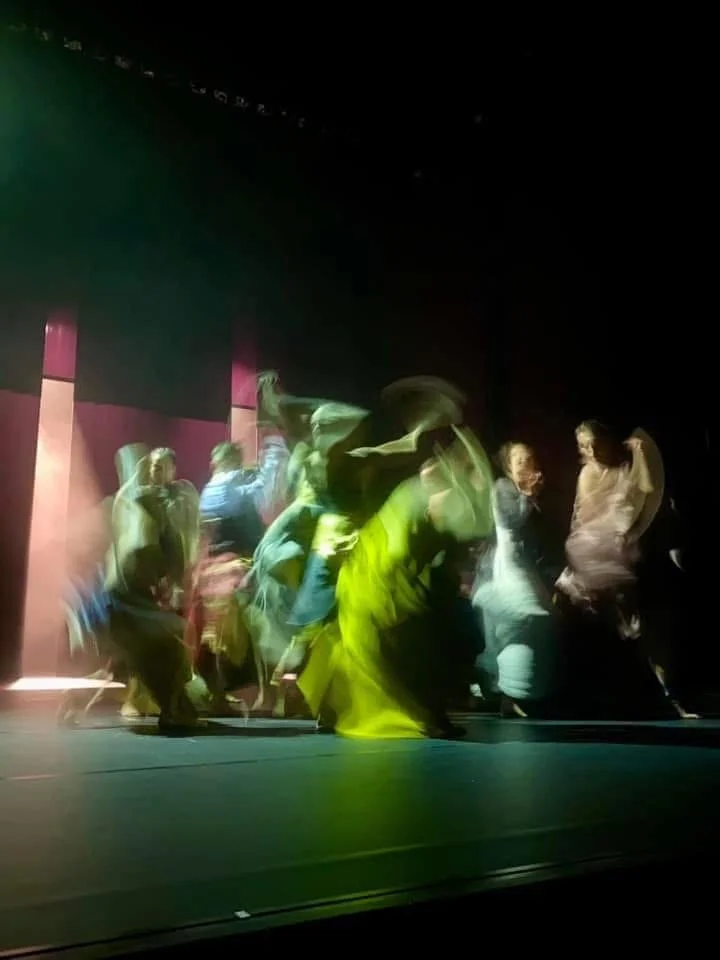
The rate of change when it comes to choreographic works, is both a creative tool and a metric to evaluate choreographic validity.
Choreographic works continuously changing isn’t a bug, it is a feature. Since the notions of a final state, or an end point to the choreographic process are a negation of the thing itself, all there can be is change informed by directional clarity.
Choreographies need to make sense directionally, which makes them radically different than how artistic objects (paintings, sculptures, texts, videos, films, musical scores etc) achieve a state of clarity and coherence.
When the rate of change is close to zero, meaning that the work doesn’t change over time, it’s a sure way to know that there’s very little choreographic substance present. Only objects do not change, all living things do.
Managing the direction and rate of change though, by being attentive to what the work does, what it asks for, where it’s going, when and how much change is needed, is a core aspect of the creative process.
This raises fundamental questions regarding the concept and practice itself of ‘repertoire’ in relations to choreographic works, which more often than not, translates to dead, object-like works by dead, or worse, living artists.
Choreography is the art of living things. All living things change continuously over time. If it doesn’t change, if it consumes all of its ressources on fixating and maintaining one specific state, it is not alive and therefore, it is not choreography.
Change is a choreographic must. Allowing for it while determining its rate and direction, is a fundamental aspect of the choreographic thing.
This is why the notion itself of ‘finishing’ a choreographic work is ridiculous, since choreographies are simply not a finite object. The main driver then for the maker, should be continuously figuring out what the work is capable of becoming.
Choreographic works can’t be bothered with being finished, since like life, they’re about iteration and consequent evolution, not execution.